
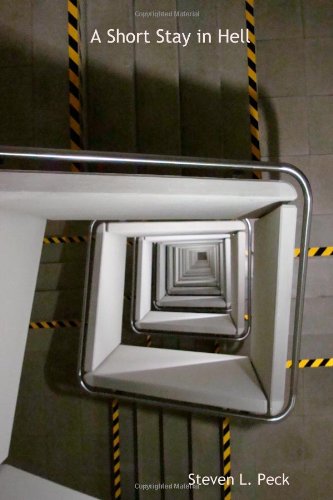
Based on your book
A Short Stay in Hell
by Steven L. Peck
A Short Stay in Hell drops you into a uniquely terrifying afterlife: a vast, infinite library where one man, an ordinary accountant named Thomas, is tasked with finding a specific book that proves the existence of God. This isn't a fire-and-brimstone hell, but something far more insidious – a bleak, mathematical eternity designed to break the spirit through endless, repetitive searching. The reading experience is intensely reflective, pulling you into Thomas's quiet despair and his desperate attempts to find meaning in a truly indifferent universe. It’s a book that invites you to ponder the nature of existence, the crushing weight of infinity, and what it means to be human when humanity itself is stretched across aeons. This is for readers who appreciate philosophical horror, existential dread, and a story that will linger long after the final page, prompting deep thought about fate, free will, and the very concept of forever.
10 Books similar to 'A Short Stay in Hell'
If Steven L. Peck's A Short Stay in Hell left you pondering the vastness of eternity and the quiet despair of an impossible task, you're in luck. We've curated a list of books that echo its distinct blend of existential crisis and labyrinthine, isolating settings. Whether you're drawn to the philosophical horror of an infinite library, the absurd logic of an inescapable afterlife, or the profound questions about meaning in a seemingly pointless existence, these recommendations explore similar dark corners of the human condition. They'll keep you contemplating fate, free will, and the strange realities of the beyond.
As an Amazon Associate, we earn from qualifying purchases.

This collection contains 'The Library of Babel,' the direct inspiration for Peck's setting. It explores the mathematical horror of infinity and the existential despair of searching for meaning within an endless, structured universe.

Like Peck's protagonist, Piranesi lives in an infinite, labyrinthine structure that defies traditional reality. The novel shares a similar sense of atmospheric isolation and the quiet, introspective struggle to understand one's place in a vast, indifferent world.

This book presents forty short, imaginative vignettes of what happens after death, often focusing on bureaucratic ironies or mathematical oddities. It mirrors Peck's creative and often unsettling approach to reimagining the afterlife as something other than traditional heaven or hell.

A quintessential existentialist play where hell is depicted as a single room shared with other people. It captures the same claustrophobic tension and the realization that eternal existence with others can be its own form of psychological torture.

Love to read on the go?
Explore Kindle e-readers and take your books with you.
As an Amazon Associate, we earn from qualifying purchases.

This surrealist novel features a protagonist trapped in a bizarre, cyclical landscape that is eventually revealed to be a unique form of hell. It matches Peck's blend of dark humor, absurdist logic, and existential dread.

The foundational text for structured afterlives, Dante's journey through the circles of hell provides the architectural and moral framework that Peck both references and subverts. It shares the themes of justice, eternal punishment, and the physical reality of the soul's journey.

by Albert Camus
While non-fiction, this philosophical essay addresses the core problem of Peck's book: how to find meaning in a repetitive, eternal, and seemingly pointless task. It provides the intellectual backbone for the protagonist's struggle against the despair of the library.

This novel features a protagonist trapped in a repeating cycle within a confined location, forced to solve a puzzle to escape. It echoes the 'escape room' feel of Peck's hell and the psychological toll of repeating the same actions over vast stretches of time.

Set in a city inhabited by those who are dead but still remembered by the living, this book explores the logistics and loneliness of the afterlife. It shares Peck's interest in the mundane aspects of eternal existence and the poignant loss of the world left behind.

by Franz Kafka
Kafka's work is the gold standard for the 'absurdist nightmare' genre that Peck utilizes. The feeling of being trapped in an incomprehensible situation with no clear rules or escape mirrors the protagonist's initial descent into the library.

Not sure what they've already read?
Let them pick their next favorite with an Amazon Gift Card.
As an Amazon Associate, we earn from qualifying purchases.
As an Amazon Associate, we earn from qualifying purchases.