
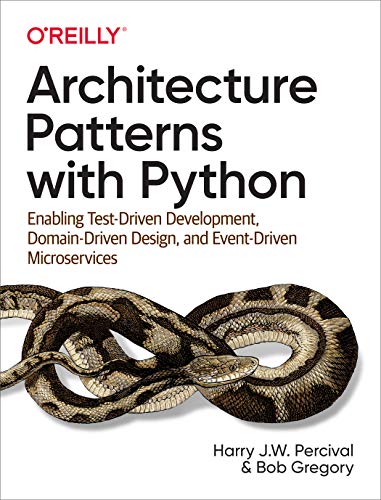
Based on your book
Architecture Patterns with Python
by Percival, Harry
Architecture Patterns with Python moves past basic syntax to address the structural headaches that emerge as a codebase grows. Percival focuses on decoupling business logic from external dependencies, using patterns like the Repository, Service Layer, and Unit of Work to bring order to complex systems. The reading experience is clinical and highly pragmatic; it feels like sitting in on a series of high-level engineering whiteboarding sessions where the goal is maintainability rather than quick fixes. You will not find fluff here. Instead, you get a rigorous exploration of how to organize code so it can withstand changing requirements without collapsing under its own weight. This is for the developer who has mastered Python basics and is now staring down the barrel of a monolithic application that feels increasingly impossible to test or evolve.
10 Books similar to 'Architecture Patterns with Python'
Since you enjoyed the analytical rigor of Percival's approach, these books were selected to bridge the gap between abstract architectural theory and the messy reality of production systems. We focused on titles that explore the philosophy of Domain-Driven Design and the practical necessity of test-driven development, as these are the intellectual pillars that hold up modern software design. Whether you are looking to refactor legacy code or scale your architecture into distributed microservices, this curated list provides the deeper context and the specific, actionable techniques needed to build resilient systems that actually last.
As an Amazon Associate, we earn from qualifying purchases.

This book serves as the foundational theory for the practical implementations found in Percival's work. It provides the essential principles of decoupling and dependency management that are critical for any developer looking to master software architecture.

by Eric Evans
This is the seminal text that introduced the patterns Percival builds upon, such as Repositories and Services. It is essential reading for anyone who wants to understand the 'why' behind the structural decisions in complex Python applications.

Fowler's classic catalog of patterns is the direct ancestor to the architectural styles discussed in Percival's book. It provides the vocabulary and structural blueprints that Python developers need to build robust, scalable enterprise systems.

Written by the same author, this book provides the crucial testing methodology that underpins the architectural patterns discussed in his later work. It is the perfect companion for understanding how to build reliable, testable codebases from the ground up.

Not sure what they've already read?
Let them pick their next favorite with an Amazon Gift Card.
As an Amazon Associate, we earn from qualifying purchases.

While Percival focuses on building new architectures, this book teaches the vital skill of evolving existing code to meet those high standards. It bridges the gap between messy legacy code and the clean, decoupled patterns advocated by modern software engineers.

This book expands the scope from application-level architecture to system-level architecture, which is the logical next step for readers who have mastered Percival's patterns. It provides a deep dive into the trade-offs involved in distributed systems and data management.

This book is the ultimate guide for developers who find themselves in the 'real world' where they must apply clean architecture patterns to existing, often messy codebases. It provides the strategies needed to refactor and test code that wasn't designed with modern patterns in mind.

by Sam Newman
For readers looking to scale the patterns described by Percival into distributed environments, this book provides the necessary architectural guidance. It focuses on the organizational and technical shifts required to move from monolithic applications to decoupled services.

While Percival focuses on high-level architecture, this book focuses on the language-specific nuances that make that architecture efficient and maintainable. It is the perfect complement for developers who want to ensure their Python implementation is as clean as their design.

by Steve Freeman and Nat Pryce
This book shares the same philosophy as Percival's work, emphasizing that testing and architecture are deeply intertwined. It provides a masterclass in how to use TDD to drive the design of a system, resulting in code that is both flexible and maintainable.

Prefer to listen?
Try Audible and hear the story instead of reading it.
As an Amazon Associate, we earn from qualifying purchases.
As an Amazon Associate, we earn from qualifying purchases.