

Based on your book
Boom and Bust
by Quinn, William
Boom and Bust offers a sober, analytical look at the recurring cycles of financial excess that have defined global history. Rather than focusing on single events, the authors examine the shared DNA of bubbles, from the Dutch tulip mania to the dot-com era. The writing feels precise and observational, stripping away the hype to reveal the underlying human psychology and systemic failures that make us repeat the same mistakes. You will not find sensationalism here; instead, the book moves with a calm, intellectual rigor that treats economics as a branch of history. It is an ideal pick for the reader who prefers cold facts and structural analysis over narrative drama. If you want to understand the mechanics behind the madness of crowds and the power dynamics that fuel market instability, this provides a remarkably clear-eyed perspective.
10 Books similar to 'Boom and Bust'
Since you appreciated how Quinn and Turner deconstructed the patterns of market failure, these recommendations were curated to deepen your understanding of financial folly. We chose these titles because they echo the same blend of historical inquiry and behavioral analysis found in Boom and Bust. Whether you are looking for the quantitative data of Reinhart and Rogoff or the narrative wit of Galbraith, these books focus on the intersection of human psychology and economic policy. They collectively map out the persistent, often irrational, forces that drive the rise and fall of global wealth.
As an Amazon Associate, we earn from qualifying purchases.

This is the seminal text on financial bubbles that serves as a foundational companion to Quinn and Turner's work. It provides a comprehensive, historical framework for understanding the recurring patterns of irrational exuberance and market collapse.
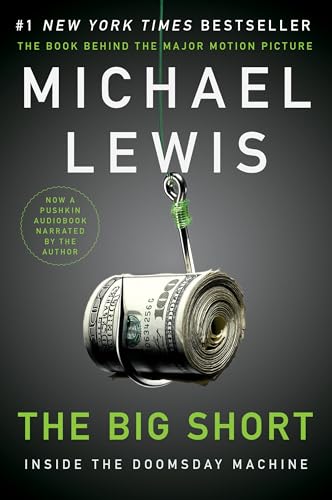
Like 'Boom and Bust,' this book masterfully dissects the mechanics of a massive financial bubble, focusing on the human behaviors and systemic failures that lead to catastrophe. Lewis combines rigorous research with a narrative style that makes complex economic events feel urgent and dramatic.

This book offers a deep, engaging exploration of the history of speculation, mirroring Quinn and Turner's focus on the cultural and psychological drivers behind market manias. It is essential reading for anyone interested in the recurring folly of investors throughout the centuries.

As the classic text on mass hysteria and financial bubbles, this book provides the historical context that underpins modern studies like 'Boom and Bust.' Readers will appreciate the timeless insight into how social psychology drives financial markets to extremes.

Prefer to listen?
Try Audible and hear the story instead of reading it.
As an Amazon Associate, we earn from qualifying purchases.

This book provides a narrative-driven look at the central bankers who navigated the economic turmoil of the early 20th century, offering a perfect complement to the systemic analysis in 'Boom and Bust.' It highlights how individual decisions and institutional failures can precipitate global financial collapse.

Shiller's work is crucial for understanding the psychological and behavioral economics behind the bubbles analyzed in 'Boom and Bust.' It bridges the gap between historical narrative and modern economic theory, explaining why markets consistently detach from reality.

Galbraith’s definitive account of the 1929 market crash remains a masterpiece of economic history and a direct ancestor to the themes explored in 'Boom and Bust.' It combines sharp wit with a sobering analysis of how markets lose their grip on reality.

by Carmen M. Reinhart and Kenneth S. Rogoff
This book provides the quantitative backbone to the qualitative history found in 'Boom and Bust,' proving that financial crises are not unique anomalies but recurring features of the global economy. It is an essential, data-driven look at the long-term history of sovereign debt and banking crises.

Sorkin provides a fly-on-the-wall account of the 2008 financial crisis, focusing on the high-stakes decision-making that mirrors the 'bust' phases described in Quinn and Turner's work. It is a gripping, detailed look at the intersection of political power and financial instability.

Ferguson traces the evolution of the financial system, providing the broad historical context that helps readers understand the origins of the bubbles discussed in 'Boom and Bust.' It is a sweeping, accessible narrative that connects the dots between ancient commerce and modern global markets.

Love to read on the go?
Explore Kindle e-readers and take your books with you.
As an Amazon Associate, we earn from qualifying purchases.
As an Amazon Associate, we earn from qualifying purchases.