
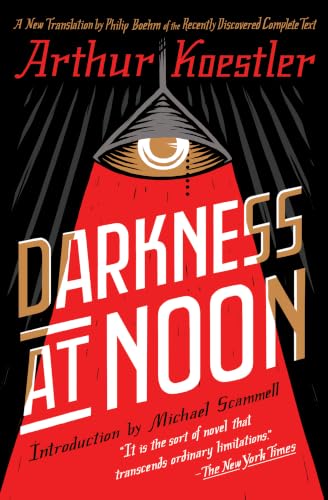
Based on your book
Darkness at Noon
by Koestler, Arthur
Rubashov is an aging revolutionary, once a powerful architect of the Soviet system, who finds himself trapped in the very gears he helped construct. Arrested during the Stalinist purges, he spends his final days in a prison cell, engaged in a grueling intellectual duel with his interrogators. The story is less about the physical confinement and more about the slow, agonizing dissection of his own conscience. Koestler strips away the veneer of revolutionary necessity, forcing you to sit with the cold, hard logic of a state that demands absolute self-abnegation. The pacing is deliberate and claustrophobic, mirroring the protagonist's descent into existential despair. This is a demanding, deeply cerebral read, perfect for those who want to examine the intersection of personal integrity and political dogma. If you are interested in the dark mechanics of power and the fragility of the individual mind, this will stay with you for a long time.
10 Books similar to 'Darkness at Noon'
The books selected here expand on the specific brand of intellectual dread Koestler mastered. If the moral rot of political systems keeps you up at night, authors like Solzhenitsyn and Serge offer a more granular look at the human cost of these regimes. For those drawn to the existential isolation of Rubashov’s cell, Kafka and Zamyatin provide the same sense of crushing, inevitable bureaucracy. These stories collectively trace the line between individual morality and the cold logic of the state, ensuring that the questions raised in Darkness at Noon continue to resonate long after the final page.
As an Amazon Associate, we earn from qualifying purchases.

As the definitive companion to Koestler's work, this novel explores the terrifying mechanics of totalitarianism and the erosion of individual thought. Both books share a bleak, analytical focus on how political systems dismantle the human spirit.

Set within a Soviet prison research institute, this novel offers a profound look at the moral compromises made under Stalin's regime. Like Koestler, Solzhenitsyn masterfully examines the intellectual's struggle against an oppressive state.

While Koestler focuses on the brutal coercion of the state, Huxley examines the insidious control through pleasure and conditioning. Both novels serve as essential critiques of how political structures manipulate human nature.

by Franz Kafka
This classic captures the same sense of claustrophobic dread and inevitable doom found in Rubashov's imprisonment. It is a quintessential exploration of an individual caught in the gears of an incomprehensible and uncaring bureaucracy.

Prefer to listen?
Try Audible and hear the story instead of reading it.
As an Amazon Associate, we earn from qualifying purchases.

This seminal work of dystopian fiction influenced both Orwell and Koestler, depicting a society where individuality is mathematically eliminated. Fans of the ideological debates in *Darkness at Noon* will appreciate the cold, logical rigidity of this regime.

Kundera weaves political history with deep philosophical inquiry into the nature of existence under communism. It shares Koestler's intellectual depth while exploring the personal consequences of life in a totalitarian state.

This harrowing account of life in a labor camp provides a visceral, ground-level view of the system that Koestler analyzed from the perspective of high-ranking party officials. It is a powerful study of human resilience in the face of absolute dehumanization.

Greene explores the intersection of personal morality and political ideology with a cynical, observant eye. Like Koestler, he examines how good intentions can lead to disastrous consequences within complex political landscapes.

This epic novel captures the sweeping, tragic impact of the Russian Revolution on the individual life. It provides a more lyrical, yet equally devastating, look at how the machinery of history crushes personal autonomy.

by Victor Serge
Written by a participant in the events described, this novel provides a panoramic view of the Stalinist purges, similar to the context of Koestler's work. It excels at showing how the paranoia of the state ripples through every level of society.

Love to read on the go?
Explore Kindle e-readers and take your books with you.
As an Amazon Associate, we earn from qualifying purchases.
As an Amazon Associate, we earn from qualifying purchases.