

Based on your book
Demonic Warfare
by Meulenbeld, Mark R. E.
Demonic Warfare is not a light read, but it is an essential one for those fascinated by the dark mechanics of power. Mark R. E. Meulenbeld explores the intersection of ritual, state authority, and the supernatural in Chinese history, revealing how the act of subduing demons was often a proxy for controlling human populations. The writing is dense, intellectual, and deeply analytical, favoring rigorous research over easy answers. You will find yourself navigating a landscape where the lines between political legitimacy and spiritual warfare blur significantly. It feels like a meticulous autopsy of belief systems, designed for readers who want to understand the moral ambiguity inherent in institutionalized religion. This book is for the scholar or the patient, curious reader who enjoys peeling back the layers of history to see how power really operates behind the mask of tradition.
10 Books similar to 'Demonic Warfare'
If the unsettling interplay of statecraft and the occult in Demonic Warfare kept you up at night, these selections offer a wider lens into the same complex machinery. We have curated these titles to bridge the gap between abstract theology and the gritty reality of political control. Whether you are looking for the historical sociology found in The Religious Question in Modern China or the raw, lived experience of ritual in The Taoist Body, these books mirror that specific tension between marginalized spiritual practices and the crushing weight of authority.
As an Amazon Associate, we earn from qualifying purchases.
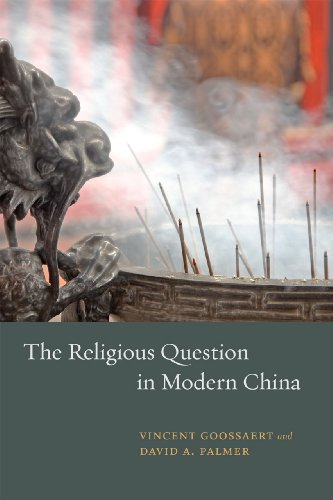
by Vincent Goossaert and David A. Palmer
Like Meulenbeld's work, this book provides a rigorous, scholarly examination of the complex interplay between religion, state power, and modernization in China. It is essential reading for those interested in the historical sociology of Chinese religious movements and how they navigate political authority.

This classic study offers a deep, immersive look into the ritual and embodied practices of Taoism, echoing Meulenbeld's focus on the lived experience of religious traditions. It provides the necessary theological and ritual context for understanding the demon-subduing practices discussed in 'Demonic Warfare'.

This book explores the intersection of witchcraft, colonial power, and religious belief in Brazil, offering a fascinating comparative perspective to Meulenbeld's study of Chinese demonic warfare. It analyzes how marginalized religious beliefs are interpreted and policed by authorities, mirroring the power dynamics in Meulenbeld's research.

For readers who appreciated the broad religious context in 'Demonic Warfare', this book offers a structured and insightful overview of the Chinese religious landscape. It helps contextualize the specific demon-subduing rituals within the broader tapestry of Chinese spiritual life.

Prefer to listen?
Try Audible and hear the story instead of reading it.
As an Amazon Associate, we earn from qualifying purchases.
Campany's work on the evolution of religious figures shares Meulenbeld's meticulous attention to how narratives and rituals are constructed and transformed over time. It provides a similar level of scholarly rigor for those interested in the formation of religious identities and supernatural hierarchies.

This book examines the institutionalization and political management of religion, which directly complements Meulenbeld's analysis of how demonic warfare was utilized by the state. It is a vital resource for understanding the macro-level political implications of religious practice.

by Xiaofei Kang
Much like 'Demonic Warfare', this book focuses on a specific, powerful supernatural entity and its role in popular culture and religious practice. It explores how these beliefs are negotiated between different social classes, making it an excellent thematic companion.
Readers interested in the theoretical underpinnings of Meulenbeld's work will find this exploration of how religious concepts shape political sovereignty deeply engaging. It bridges the gap between theology and political science, much like the case studies in 'Demonic Warfare'.

While it focuses on a different region, Scott's analysis of how communities resist state control through cultural and religious practices provides a brilliant counter-narrative to the state-centered view of religion. It offers a fresh perspective on the 'outsider' religious traditions often found in demon-subduing literature.
by Livia Kohn
This book serves as an excellent reference guide for the specific figures and concepts that Meulenbeld analyzes, providing deeper insight into the lore itself. It is perfect for readers who want to understand the 'who' and 'what' behind the 'why' of the rituals described in 'Demonic Warfare'.

Love to read on the go?
Explore Kindle e-readers and take your books with you.
As an Amazon Associate, we earn from qualifying purchases.
As an Amazon Associate, we earn from qualifying purchases.