
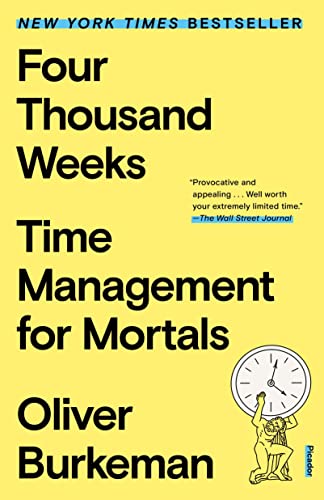
Based on your book
Four Thousand Weeks
by Burkeman, Oliver
If you have ever felt like your to-do list is a treadmill that only speeds up, Oliver Burkeman offers a rare, grounded perspective on the finite nature of our lives. Instead of promising you the secret to managing your time more efficiently, he argues that the very quest for productivity is a trap. The book is remarkably honest and refreshingly low-pressure, reading less like a self-help manual and more like a long, thoughtful conversation with a friend who has finally stopped trying to impress anyone. Burkeman guides you toward accepting the reality of your own limitations rather than fighting them. This is essential reading for anyone feeling burnt out by the modern cult of optimization, or for those who suspect that the secret to a meaningful life isn't doing more, but choosing what to leave undone.
10 Books similar to 'Four Thousand Weeks'
Since you enjoyed the existential clarity of Burkeman's work, these ten titles were selected to help you further dismantle the productivity trap and reclaim your agency. Whether you are looking for the stoic grounding of Marcus Aurelius, the systemic critique of Johann Hari's research on attention, or the practical philosophy of Greg McKeown, these books share a common thread: they urge you to stop optimizing for everyone else's expectations. This collection focuses on the intersection of mortality, intentional living, and the quiet courage required to reject the constant noise of the modern attention economy.
As an Amazon Associate, we earn from qualifying purchases.

Written by the same author, this book serves as a perfect companion piece that explores the 'negative path' to happiness. It challenges the modern obsession with relentless positivity, mirroring the counterintuitive wisdom found in Four Thousand Weeks.

by Greg McKeown
While Burkeman focuses on the philosophy of time, McKeown provides a practical framework for applying those limitations to your life. Both books advocate for doing less but doing it better, emphasizing the importance of choosing what truly matters.

As a foundational text of Stoicism, this book deeply resonates with the existential acceptance of mortality that Burkeman champions. It offers timeless advice on focusing only on what is within your control, a core pillar of the 'four thousand weeks' mindset.

This profound work explores finding purpose despite suffering and limitations, grounding the abstract concepts of time and mortality in real-world experience. It aligns with Burkeman's argument that acknowledging our finite nature is the key to a meaningful existence.

Love to read on the go?
Explore Kindle e-readers and take your books with you.
As an Amazon Associate, we earn from qualifying purchases.

by Cal Newport
Newport addresses the specific modern distraction that Burkeman warns against: the endless, shallow consumption of digital content. It provides a structured approach to reclaiming your time and attention from the forces that seek to exploit them.

by Ichiro Kishimi and Fumitake Koga
Presented as a dialogue between a philosopher and a student, this book challenges conventional wisdom about happiness and interpersonal relationships. It shares Burkeman's skepticism of self-help tropes and encourages a radical shift in perspective regarding one's own agency.

by Johann Hari
Hari investigates the systemic reasons why our attention spans are failing, complementing Burkeman's focus on how we waste our limited time. Both authors argue that the problem is not a personal failure, but a structural one that requires a change in how we live.

by Jenny Odell
Odell makes a compelling case for stepping back from the productivity-obsessed 'attention economy' to reconnect with our physical environment. It echoes Burkeman's call to resist the urge to optimize every second and instead embrace the value of simply existing.

by Atul Gawande
Gawande explores the reality of aging and death within the medical system, offering a poignant look at how we should spend our final days. It provides a grounding, real-world application of the existential acceptance that Burkeman encourages readers to adopt.

by Devon Price
Price dismantles the 'laziness lie' that makes us feel guilty for not being constantly productive, aligning perfectly with Burkeman's critique of the productivity cult. It is an empowering read for anyone feeling burnt out by the pressure to constantly achieve.

Not sure what they've already read?
Let them pick their next favorite with an Amazon Gift Card.
As an Amazon Associate, we earn from qualifying purchases.
As an Amazon Associate, we earn from qualifying purchases.