
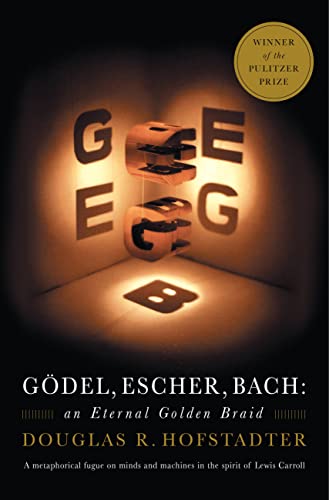
Based on your book
Gödel, Escher, Bach
by Hofstadter, Douglas R
Douglas Hofstadter asks a deceptively simple question: how do inanimate things like neurons or silicon chips give rise to the conscious, thinking self? He explores this by weaving together the logic of Kurt Godel, the impossible geometry of M.C. Escher, and the fugues of J.S. Bach. The result is a massive, recursive meditation on how systems generate meaning through self-reference. Reading this is an exercise in intellectual stamina; it feels like a long, playful conversation with an incredibly brilliant friend who refuses to give you the easy answers. You will encounter fictional dialogues, brain teasers, and rigorous mathematical proofs alongside deep existential inquiry. It is intended for the curious reader who finds joy in the architecture of thought itself, prefers the journey of questioning over the destination of certainty, and does not mind getting lost in a labyrinth of complex ideas.
10 Books similar to 'Gödel, Escher, Bach'
Since you appreciate how Gödel, Escher, Bach dismantles the barriers between art, logic, and consciousness, these titles were curated to satisfy that same hunger for structural complexity. Whether through the clinical observations of Oliver Sacks or the mathematical labyrinths of Jorge Luis Borges, each selection explores the strange loops of human existence. We chose these books because they mirror Hofstadter's fascination with self-reference, the nature of intelligence, and the hidden patterns governing our reality. If you want to continue examining the intersection of physics, philosophy, and the mind, these explorations offer equally rigorous intellectual terrain.
As an Amazon Associate, we earn from qualifying purchases.

Like Hofstadter, Penrose explores the boundaries between physics, consciousness, and mathematics, challenging the notion that computers can ever truly replicate the human mind. It is a dense, intellectually rigorous journey that appeals to the same curiosity about the nature of intelligence and reality.

This classic novella uses geometry and a fictional world to explore higher dimensions and social hierarchy, mirroring the playful yet profound way Hofstadter uses metaphors to explain complex systems. It is essential reading for anyone who enjoys the intersection of mathematics and philosophical allegory.

by Douglas R. Hofstadter and Daniel C. Dennett
Co-edited by Hofstadter himself, this anthology collects essays and stories that delve into the nature of the self and the mind. It serves as a perfect companion piece to GEB, expanding on the themes of recursion, consciousness, and what it means to be a thinking being.

Hofstadter explicitly revisits and refines the core ideas of GEB in this deeply personal work, focusing on the concept of the 'strange loop' as the basis for the self. It is a more accessible and emotional exploration of the same themes that made his earlier masterpiece so iconic.

Love to read on the go?
Explore Kindle e-readers and take your books with you.
As an Amazon Associate, we earn from qualifying purchases.

Borges's short stories are literary equivalents to the recursive, mind-bending structures found in GEB, often dealing with infinite libraries, labyrinths, and philosophical paradoxes. Fans of Hofstadter’s playful intellectualism will find much to admire in Borges’s mastery of conceptual fiction.

by James Gleick
Gleick chronicles the development of chaos theory, a field that shares GEB's fascination with how simple rules can generate complex, unpredictable patterns. It captures the same spirit of scientific discovery and the awe of finding order within apparent disorder.

by James Gleick
This book traces the evolution of information theory, a cornerstone of the cognitive science and logic explored throughout GEB. It provides a historical and scientific context for understanding the patterns and systems that Hofstadter so brilliantly analyzes.

This experimental novel reflects the solitary, recursive nature of consciousness and the struggle to define reality through language and logic. It mirrors the philosophical weight of GEB while providing a unique, fragmented narrative structure that demands active reader engagement.

Dennett provides a rigorous, materialist account of consciousness that complements the philosophical inquiries found in Hofstadter's work. Readers who enjoyed the 'Ant Fugue' or the dialogues in GEB will appreciate Dennett’s approach to dismantling the 'Cartesian Theater' of the mind.

by Oliver Sacks
Sacks explores the profound mysteries of the human brain through clinical case studies, revealing how the 'self' is constructed and how it can break down. It provides a humanistic, narrative counterpoint to the more abstract, mathematical explorations of cognition found in GEB.

Not sure what they've already read?
Let them pick their next favorite with an Amazon Gift Card.
As an Amazon Associate, we earn from qualifying purchases.
As an Amazon Associate, we earn from qualifying purchases.