
Based on your book
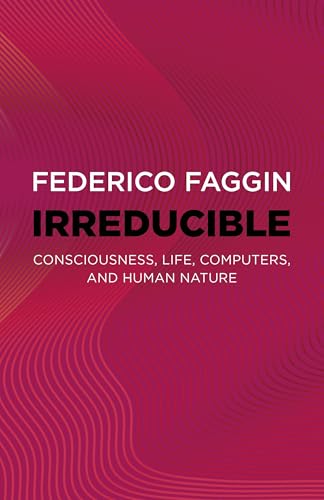
Irreducible
by Faggin, Federico
Federico Faggin, the engineer behind the first microprocessor, turns his intellect toward the one thing silicon cannot replicate: the subjective experience of being alive. Irreducible is a bold rejection of the materialist dogma that consciousness is merely a byproduct of complex computation. Instead, Faggin argues that awareness is the fundamental fabric of reality. The pacing is deliberate and introspective, reading less like a standard scientific treatise and more like a long-form meditation from a brilliant mind grappling with the limits of his own creation. It is an honest, often vulnerable inquiry that bridges the gap between hard physics and the profound mystery of the self. If you find yourself questioning whether your internal life is an accidental glitch or the very point of existence, this book will provide a rigorous, intellectually stimulating framework for your own existential investigation.
10 Books similar to 'Irreducible'
The books selected here were chosen because they mirror Faggin's refusal to accept that our reality is purely mechanical or algorithmic. If you find your curiosity piqued by his synthesis of science and spirit, these titles offer further exploration into why consciousness likely precedes physical matter. We have curated a list that spans quantum biology, philosophical critiques of neo-Darwinism, and the intersection of contemplative practice with neuroscience. Together, they form a cohesive library for anyone eager to challenge the standard materialist narrative and dig deeper into the irreducible nature of existence.
As an Amazon Associate, we earn from qualifying purchases.

Like Faggin, Kafatos bridges the gap between quantum physics and consciousness, arguing that the universe is an integrated whole. Readers interested in the fundamental nature of reality versus the limitations of materialism will find this a deeply satisfying companion piece.

This seminal work challenges the idea that human consciousness can be reduced to computational algorithms, a core argument in Faggin's work. It provides the rigorous scientific foundation for why AI may never truly replicate the human mind.

by Thomas Nagel
Nagel provides a philosophical critique of the standard neo-Darwinian materialist view of the universe, echoing Faggin's skepticism about purely mechanistic explanations of life. It is a dense but rewarding exploration of why consciousness must be a fundamental feature of nature.

Hoffman argues that our perceptions of the world are not objective truths but user interfaces, aligning with Faggin's view that consciousness precedes physical matter. It is a fascinating look at how our biological evolution has shaped, and limited, our understanding of the 'real' world.

Prefer to listen?
Try Audible and hear the story instead of reading it.
As an Amazon Associate, we earn from qualifying purchases.

While narratively different, this book shares the deep, obsessive inquiry into the nature of quality, reality, and the synthesis of technology with the human spirit. It captures the same spirit of a brilliant mind attempting to unify disparate fields of knowledge.

This book explores the emerging field of quantum biology, suggesting that life processes rely on quantum mechanical phenomena. It provides a scientific grounding for the 'irreducible' nature of life that Faggin discusses from a more philosophical and experiential perspective.

by Brian Greene
Greene explores the vast possibilities of the multiverse, challenging our limited human perspective on what is 'real.' Fans of Faggin will appreciate the way this book pushes the boundaries of scientific imagination to consider the fundamental architecture of existence.

by Sam Harris
Harris explores the nature of consciousness through the lens of both neuroscience and contemplative practice, mirroring Faggin's own journey of reconciling scientific inquiry with subjective experience. It is a pragmatic guide to understanding the 'self' as an illusion.

Deutsch proposes a 'Theory of Everything' that integrates quantum physics, epistemology, and computation. It shares the ambitious, interdisciplinary scope of Faggin's work and will appeal to readers who enjoy bold, paradigm-shifting arguments about the nature of the universe.

by Robert Lanza
Lanza posits that life and consciousness are fundamental to the universe, and that biology creates reality rather than the other way around. This aligns perfectly with the central thesis of 'Irreducible' and serves as a compelling companion for those exploring panpsychist ideas.

Love to read on the go?
Explore Kindle e-readers and take your books with you.
As an Amazon Associate, we earn from qualifying purchases.
As an Amazon Associate, we earn from qualifying purchases.