
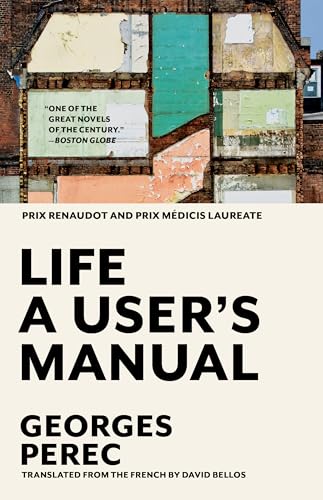
Based on your book
Life A User's Manual
by Perec, Georges
Imagine a Parisian apartment block sliced open like a dollhouse, revealing the bizarre, tragic, and mundane lives of its inhabitants. Georges Perec treats his characters not just as people, but as pieces in an elaborate, self-imposed puzzle. The narrative jumps between rooms and eras, cataloging the physical detritus of their existences—from stamp collections to unfinished paintings—with a clinical, almost obsessive precision. It is a dense, playful, and deeply melancholic look at the human impulse to categorize the chaos of life. You will not find a traditional plot here; instead, you get a sprawling architectural blueprint of human memory and missed connections. This is a book for the reader who values structural ingenuity over linear storytelling, and who finds beauty in the quiet, idiosyncratic details that define a life.
10 Books similar to 'Life A User's Manual'
If the puzzle-box architecture of Perec's apartment block left you craving more, these selections lean into that same spirit of formal experimentation and spatial obsession. We chose these titles because they share a fascination with the way physical environments, like hotels or imaginary cities, act as containers for complex human histories. Whether through the surreal logic of Flann O'Brien or the hyper-focused observations of Nicholson Baker, these books reward readers who enjoy dissecting the mechanics of existence. They are curated for anyone who views literature as a game of intricate, interconnected parts.
As an Amazon Associate, we earn from qualifying purchases.

Like Perec, O'Brien delights in the absurdity of logic and the construction of elaborate, surreal systems. This novel shares a similarly playful yet deeply unsettling tone, where the rules of the world are constantly shifting in ways that feel both mathematical and nightmarish.

This is the quintessential companion piece to Perec's work, as both authors were key members of the Oulipo group. It plays with the structure of the novel itself, offering a nested, puzzle-like reading experience that constantly challenges the reader's relationship with the text.

by Amor Towles
Focusing on a single building (the Metropol Hotel) as a microcosm of a larger society, this book mirrors Perec's obsession with spatial constraints and the rich, interconnected lives within a confined setting. It offers a more gentle, character-driven exploration of history and endurance.

For readers who loved Perec's obsession with the minutiae of everyday objects and the 'infra-ordinary,' this novel is a perfect match. It turns a simple lunch break into a sprawling, hyper-detailed meditation on the mechanics of modern existence.

Not sure what they've already read?
Let them pick their next favorite with an Amazon Gift Card.
As an Amazon Associate, we earn from qualifying purchases.

This novel shares Perec's love for structural complexity and the interweaving of disparate narratives across time and space. It builds a massive, puzzle-box architecture that rewards the attentive reader who seeks connections between seemingly unrelated stories.

This sweeping family saga captures the same sense of a house as a repository of memory and history that Perec explores. It connects generations through a web of secrets and coincidences, grounded in a rich, almost architectural sense of place.

Borges is a primary ancestor to Perec's style, utilizing short, dense, and intellectually rigorous stories that function as labyrinths. Readers who enjoy the encyclopedic, game-like quality of Perec will find Borges's philosophical puzzles equally addictive.

by Paul Auster
Auster deconstructs the detective genre in a way that feels very much in conversation with Perec's formal experimentation. These stories are less about solving a crime and more about the existential unraveling of the characters within the grid of New York City.

by W.G. Sebald
Sebald’s work is a masterful blend of memoir, history, and fiction that mirrors Perec’s fascination with the traces people leave behind in physical spaces. It is a meditative, wandering text that builds a profound sense of melancholy and historical weight through meticulous observation.
This book acts as a conceptual map of human experience, much like Perec's building. It is a series of prose poems describing imaginary cities, each one a distinct puzzle or philosophical thought experiment that demands the reader's full engagement.

Prefer to listen?
Try Audible and hear the story instead of reading it.
As an Amazon Associate, we earn from qualifying purchases.
As an Amazon Associate, we earn from qualifying purchases.