

Based on your book
The Case Against Reality
by Hoffman, Donald
Donald Hoffman asks you to consider that everything you see—tables, stars, people—is not the objective truth of the world, but a simplified interface designed by evolution to keep you alive. He argues that our senses are not windows into reality, but icons on a desktop that hide the complex, non-physical machinery beneath. Reading this feels like having the rug pulled out from under your feet, but in a way that is intellectually exhilarating rather than frightening. Hoffman balances rigorous evolutionary theory with a playful, almost subversive tone, constantly challenging your most basic assumptions about existence. This is for the reader who enjoys a good existential vertigo, someone who prefers questioning the nature of consciousness over reading a standard science textbook. If you are comfortable with your worldview being dismantled, this book will leave you looking at every sunrise with fresh suspicion.
10 Books similar to 'The Case Against Reality'
If Hoffman's work left you craving more existential disruption, these titles were chosen to help you navigate the wreckage of your own perception. We curated these selections to bridge the gap between hard neuroscience and pure philosophy, focusing on the mechanical fragility of human consciousness. Whether you are exploring the biological hardware of the brain with Dehaene and Ramachandran or contemplating the abstract, mathematical architecture of the universe with Rovelli and Hofstadter, these books reinforce the idea that your subjective experience is merely a thin layer over a much deeper, more alien reality.
As an Amazon Associate, we earn from qualifying purchases.

by Anil Seth
Like Hoffman, Seth explores the neuroscience of perception, arguing that our conscious experience is a 'controlled hallucination' generated by the brain. It provides a rigorous, scientific, yet accessible companion to the idea that our reality is a construct rather than an objective truth.
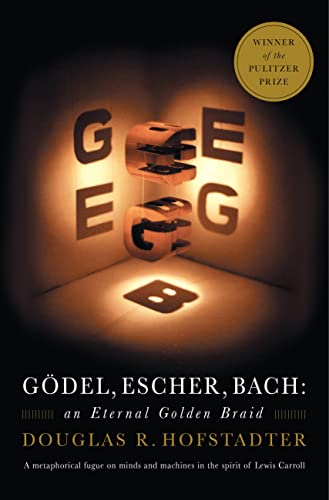
This masterpiece delves into the nature of systems, self-reference, and consciousness, challenging how we understand the 'reality' of cognition. Fans of Hoffman's structural deconstruction of reality will appreciate the immense intellectual depth and playful complexity found here.

Rovelli dismantles our intuitive understanding of time, much like Hoffman dismantles our intuitive understanding of space and objects. It is a poetic, scientific exploration that forces the reader to confront how limited our human perspective truly is.

This book bridges the gap between general relativity and quantum mechanics, questioning the fundamental nature of the universe. Readers who enjoyed Hoffman's challenge to physicalism will find this a perfect exploration of the 'hidden' nature of the physical world.

Prefer to listen?
Try Audible and hear the story instead of reading it.
As an Amazon Associate, we earn from qualifying purchases.

Ramachandran uses clinical case studies to show how easily the brain can be deceived, providing empirical evidence for the fragility of our perceived reality. It serves as a grounded, fascinating look at the neurological mechanics that Hoffman theorizes about.

by Brian Greene
Greene explores the possibility that our reality is just one of many, pushing the boundaries of physics and cosmology. It shares Hoffman's ambition to look past the surface of our immediate environment to understand the underlying architecture of existence.

Dehaene offers a rigorous scientific account of how the brain creates conscious experience, focusing on the 'global neuronal workspace.' It is an essential read for anyone interested in the biological hardware that Hoffman argues is merely a user interface.

by Thomas Nagel
Nagel critiques the materialist view of evolution, suggesting that standard Darwinian accounts cannot fully explain the emergence of consciousness. It aligns with Hoffman's skepticism toward traditional physicalism and invites deep philosophical inquiry.

A concise and elegant introduction to the revolutions of modern physics that changed our understanding of the universe. It shares the same 'awe-inspiring' tone as Hoffman's work, making complex scientific concepts feel deeply personal and philosophical.

This book argues that our conscious experience is a highly compressed, simplified version of the massive amount of data our senses receive, much like Hoffman's 'desktop' metaphor. It is a foundational text for understanding the limitations of human perception.

Love to read on the go?
Explore Kindle e-readers and take your books with you.
As an Amazon Associate, we earn from qualifying purchases.
As an Amazon Associate, we earn from qualifying purchases.