

Based on your book
The Coddling of the American Mind
by Greg Lukianoff
The Coddling of the American Mind takes a clear-eyed look at the perplexing cultural shifts unfolding on college campuses, and increasingly, beyond. Greg Lukianoff and Jonathan Haidt argue that much of the anxiety, polarization, and demands for "safety" over free inquiry stem from three deeply ingrained, yet psychologically damaging "Great Untruths" that have permeated modern childhood and education. Reading this book feels like engaging in a rigorous, yet accessible, intellectual exploration. It’s analytical and thought-provoking, laying out complex psychological and sociological arguments without ever feeling academic or dry. You'll gain a deeper understanding of why things feel so divided, and what the long-term implications are for individual development and societal well-being. This is for anyone who's puzzled by contemporary social dynamics, concerned about free speech, or simply wants to understand the forces shaping the next generation.
10 Books similar to 'The Coddling of the American Mind'
If you found yourself captivated by the insightful cultural analysis in The Coddling of the American Mind, you'll appreciate these further explorations. Our selections delve deeper into the moral psychology that divides us, the critical importance of free speech in a healthy society, and the dangers of fostering fragility instead of resilience. These books continue the conversation, offering diverse perspectives on how we navigate complex social shifts and protect the foundations of open inquiry. They're perfect for readers who want to keep unraveling the threads of modern societal challenges.
As an Amazon Associate, we earn from qualifying purchases.

As it is written by one of the co-authors of The Coddling of the American Mind, this book provides the foundational moral psychology necessary to understand why different groups see the world so differently. It explores the evolutionary origins of morality and how 'moral matrices' bind us together while blinding us to alternative perspectives.

This book challenges the idea that the human mind has no innate traits, a concept central to the debates on education and social engineering found in Lukianoff and Haidt's work. Pinker uses cognitive science to argue against the 'tabula rasa' view, providing a rigorous intellectual framework for understanding human behavior.

Written by a former president of the ACLU, this book echoes the free speech concerns central to The Coddling of the American Mind. Strossen argues that 'counterspeech' is a more effective tool against hate than censorship, aligning with the authors' views on cognitive behavioral therapy and resilience.

by Gad Saad
Gad Saad applies evolutionary psychology to the 'idea pathogens' that he believes are currently undermining Western universities and rational discourse. This book shares the same critical stance on modern campus culture and the 'safetyism' movement described by Lukianoff and Haidt.

Not sure what they've already read?
Let them pick their next favorite with an Amazon Gift Card.
As an Amazon Associate, we earn from qualifying purchases.

A classic defense of free inquiry, this book explains how the 'liberal science' of open debate is the only way to find truth. It mirrors the concerns about the erosion of viewpoint diversity and the rise of emotional reasoning in academic settings.

This more recent work by Rauch explores how our 'epistemic environment' is being corrupted by social media and cancel culture. It provides a modern update to the themes of cognitive distortions and the importance of institutional resilience found in The Coddling of the American Mind.
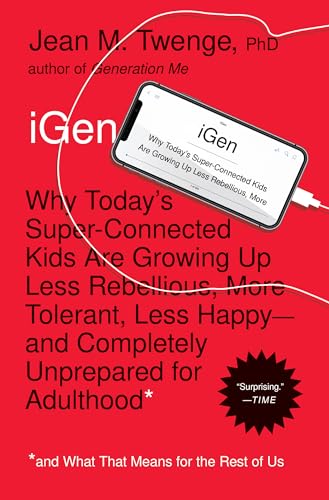
Twenge's research on the 'iGen' generation is cited extensively in The Coddling of the American Mind. This book provides the data-driven background on how smartphones and social media have contributed to the rise in anxiety and the shift in campus culture.

Murray examines the 'tripwires' of modern social justice movements, focusing on how identity politics has reshaped public discourse. Like Lukianoff and Haidt, he critiques the move away from objective truth toward subjective, identity-based validation.

The concept of 'antifragility' is a cornerstone of The Coddling of the American Mind. Taleb explains why systems (and people) need stress and challenge to grow stronger, providing the philosophical basis for why 'safetyism' is ultimately harmful to development.
by Bradley Campbell and Jason Manning
This sociological study identifies a shift from 'honor cultures' and 'dignity cultures' to a new 'victimhood culture.' It provides the academic framework for understanding the specific social dynamics and moral shifts that Lukianoff and Haidt observe on college campuses.

Prefer to listen?
Try Audible and hear the story instead of reading it.
As an Amazon Associate, we earn from qualifying purchases.
As an Amazon Associate, we earn from qualifying purchases.