
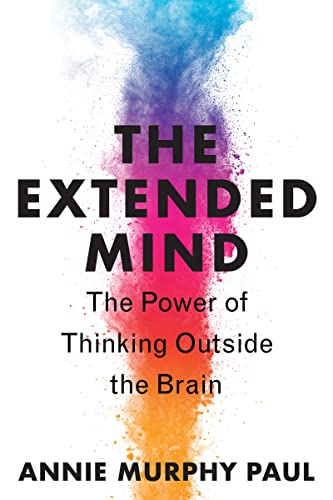
Based on your book
The Extended Mind
by Paul, Annie Murphy
Annie Murphy Paul challenges the long-held assumption that our thinking happens exclusively within the confines of our skulls. She argues that we are actually at our best when we offload cognitive tasks onto our bodies, our physical environments, and our social relationships. The book is an analytical yet accessible tour of how we can improve our focus, creativity, and problem-solving by intentionally curating the spaces and interactions around us. Reading this feels like a long, clarifying conversation with a mentor who is handing you a new set of tools for your mental workbench. It is measured and evidence-based, moving at a steady, thoughtful pace that invites you to pause and re-examine your own daily routines. This is for the reader who feels intellectually restless and wants practical, research-backed ways to work smarter by changing their relationship with the world outside their head.
10 Books similar to 'The Extended Mind'
Since you enjoyed The Extended Mind, you might appreciate these books that similarly rethink the boundaries between our internal lives and the world we inhabit. We have curated these selections because they share a focus on cognitive optimization through environmental design and behavioral habits. Whether you are looking to curate your workspace like in Deep Work, build better habits like in Atomic Habits, or understand the biological foundations of your thought process like in Thinking, Fast and Slow, these titles reinforce the idea that your potential is shaped by the structures you build around your mind.
As an Amazon Associate, we earn from qualifying purchases.

Like Paul's work, this book challenges conventional wisdom about how our minds function, specifically dismantling the idea that emotions are hardwired biological responses. It offers a rigorous, scientific, yet accessible exploration of how our constructed reality shapes our internal experience.

This book shares the empowering, research-backed focus of 'The Extended Mind' by examining how our beliefs about our own intelligence and abilities dictate our success. It provides actionable insights into how we can reshape our cognitive habits to achieve better outcomes.

Epstein's work mirrors the interdisciplinary curiosity found in 'The Extended Mind,' arguing against the narrow focus of specialization. It encourages readers to look outside their immediate 'box' to solve problems, much like Paul encourages us to look outside our brains.

by Susan Cain
Cain’s book, much like 'The Extended Mind,' takes a deep dive into how environmental and social structures impact our cognitive and emotional performance. It validates the idea that our surroundings—and how we interact with them—profoundly affect our potential.

Not sure what they've already read?
Let them pick their next favorite with an Amazon Gift Card.
As an Amazon Associate, we earn from qualifying purchases.

Fans of Paul's practical approach to cognition will appreciate Levitin's focus on how to manage the vast amounts of information we encounter daily. It provides a similar blend of neuroscience and practical advice on how to offload mental tasks to our environment.

by James Clear
This book aligns perfectly with the 'Extended Mind' philosophy that our environment dictates our behavior. Clear provides a structural framework for designing your surroundings to support your cognitive and behavioral goals, making it a natural companion read.
As a seminal work in cognitive science, this book provides the foundational understanding of how our brains work, which serves as the perfect precursor to Paul's argument about extending that mind beyond the skull. It is essential reading for anyone interested in the mechanics of thought.
by Cal Newport
Newport’s focus on the environmental and structural conditions required for high-level cognitive performance echoes Paul’s emphasis on the 'extended' nature of our work. Both authors argue that we must actively curate our surroundings to achieve our full mental potential.

While 'The Extended Mind' looks at how we can use the environment to *improve* thinking, Carr looks at how our technological environment is *reshaping* it in potentially negative ways. They offer two sides of the same coin regarding environmental influence.
This classic text explores the state of 'flow,' which is deeply connected to how we interact with our tasks and environment. Readers who enjoyed Paul's exploration of cognitive optimization will find the roots of that concept here.

Prefer to listen?
Try Audible and hear the story instead of reading it.
As an Amazon Associate, we earn from qualifying purchases.
As an Amazon Associate, we earn from qualifying purchases.