
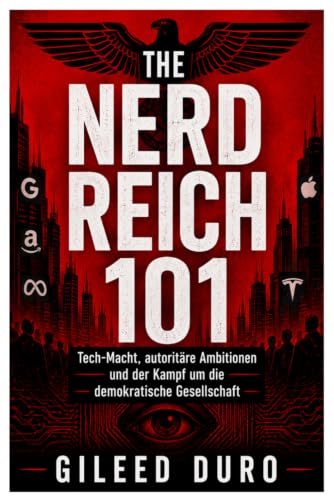
Based on your book
THE NERD REICH 101
by Duro, Gileed
Gileed Duro takes a scalpel to the digital echo chambers that define our modern era, arguing that contemporary nerd culture has evolved into something far more rigid and exclusionary than its origins suggested. The book moves at a frantic, analytical pace, dissecting how fandoms morph into political monoliths capable of enforcing strict ideological purity. It is an uncomfortable read, designed to make you question whether your own online communities are fostering genuine connection or merely narrowing your worldview. Duro writes with a biting, satirical edge that keeps the heavy sociological concepts from feeling like a textbook. This is for the reader who feels uneasy about the direction of internet discourse and wants a blunt, intellectual framework to understand why digital tribalism feels so much like a new form of totalitarianism.
10 Books similar to 'THE NERD REICH 101'
If you finished this book and felt a lingering sense of alarm, these ten titles provide the necessary context to understand why. We selected these works because they mirror Duro’s focus on the mechanics of group-think, the erosion of objective truth, and the psychological allure of mass movements. Whether you are looking for the historical foundations of propaganda or contemporary studies on the collapse of expertise, these books bridge the gap between Duro’s sharp social commentary and the broader reality of our digital age. They are essential companions for mapping the architecture of our current cultural divide.
As an Amazon Associate, we earn from qualifying purchases.

by Neil Postman
Like 'The Nerd Reich 101,' this book offers a sharp, critical look at how media consumption shapes our cultural and political reality. It provides the intellectual framework for understanding how entertainment-obsessed societies lose their capacity for serious discourse.

by Greg Lukianoff and Jonathan Haidt
This book explores the psychological and cultural shifts in modern discourse, mirroring Duro's concerns about how specific ideological bubbles impact behavior and societal health. It is essential reading for those interested in the sociology of modern grievance culture.

by Ernest Cline
While this is a work of fiction, it serves as the ultimate case study for the 'nerd culture' obsession critiqued in Duro's work. Readers can examine the same pop-culture-saturated world through a narrative lens to see if the critique holds up.

To understand the mechanics of how online subcultures and fandoms are manipulated or radicalized, one must look at the foundational texts of mass psychology. This provides the historical context for the modern 'culture war' dynamics discussed in 'The Nerd Reich 101.'

Prefer to listen?
Try Audible and hear the story instead of reading it.
As an Amazon Associate, we earn from qualifying purchases.

by Carl Sagan
Sagan’s classic defense of critical thinking against the rising tide of pseudoscience and tribalism resonates deeply with the skepticism Duro applies to modern fandom. It offers a hopeful but stern warning about the consequences of abandoning objective truth.

by Tom Nichols
This book analyzes the collapse of trust in established knowledge, a phenomenon heavily present in the echo chambers of the internet. It complements Duro's critique by explaining why online communities often reject authority in favor of group-think.

by Jon Ronson
Ronson investigates the volatile nature of online mobs and the culture of outrage, which is a central theme in 'The Nerd Reich 101.' It provides a humanizing, yet frightening, look at how digital communities enforce ideological conformity.

For readers interested in the themes of language control and ideological purity, this classic dystopian novel is the ultimate blueprint. It mirrors the anxieties about 'thought-policing' that Duro identifies within modern subcultures.

Crawford argues against the abstraction of modern digital life, offering a refreshing counter-narrative to the screen-obsessed existence critiqued by Duro. It is a thoughtful examination of how we lose touch with reality through our digital habits.

by Eric Hoffer
Hoffer’s seminal work on why people join fanatical movements is the perfect companion to 'The Nerd Reich 101.' It explains the underlying human need for belonging that often leads individuals into toxic, extremist subcultures.

Love to read on the go?
Explore Kindle e-readers and take your books with you.
As an Amazon Associate, we earn from qualifying purchases.
As an Amazon Associate, we earn from qualifying purchases.