
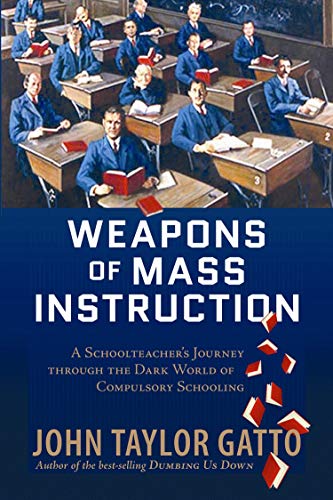
Based on your book
Weapons of Mass Instruction
by Gatto, John Taylor
John Taylor Gatto spent decades as a decorated public school teacher before concluding that the entire system is designed to stifle individual agency rather than foster it. In this book, he dissects how modern schooling functions as a tool for social control, breaking down the psychological and historical mechanisms that turn potential thinkers into compliant employees. The writing is sharp, cynical, and deeply intellectual, reading less like a textbook and more like a manifesto from a frustrated insider who has seen too much. You will feel the weight of his conviction on every page, which makes for an intentionally uncomfortable but clarifying experience. This is for readers who feel that something is fundamentally broken in our culture and are looking for a rigorous, philosophical framework to help them reclaim their own cognitive independence from institutional influence.
10 Books similar to 'Weapons of Mass Instruction'
Since you found the arguments in this book so compelling, we have curated a selection that deepens your exploration of educational autonomy and systemic critique. Whether you want to ground these ideas in economic data, historical research, or alternative philosophies of child-rearing, these titles share a common thread of rebellion against the status quo. We chose these specific works because they move beyond mere complaint to offer actionable perspectives on how to foster genuine intellectual growth outside the traditional factory model of schooling. They are the perfect companions for further dismantling your own assumptions.
As an Amazon Associate, we earn from qualifying purchases.

As the foundational text that precedes his later works, this book offers a more focused critique of the specific mechanisms of public education. Fans of Gatto's sharp, polemical style will find this essential reading for understanding the roots of his arguments against institutional schooling.

by Ivan Illich
Illich provides the philosophical bedrock for the modern unschooling movement, arguing that institutional education stifles genuine learning. Readers who appreciated Gatto's radical critique of the state's role in child development will find Illich's arguments equally challenging and intellectually rigorous.

This is Gatto's magnum opus, a deep historical dive into the origins and agendas of the American school system. It is the perfect follow-up for readers who want the complete historical context behind the claims made in Weapons of Mass Instruction.

by Peter Gray
While Gatto focuses on the 'why' of the system's failure, Gray provides a scientific and psychological look at the 'how' of natural learning. It offers a hopeful, evidence-based alternative to the rigid structures Gatto criticizes.

Prefer to listen?
Try Audible and hear the story instead of reading it.
As an Amazon Associate, we earn from qualifying purchases.

by Bryan Caplan
Caplan takes an economic approach to the same frustrations Gatto expresses, arguing that much of modern schooling is about signaling rather than actual skill acquisition. It provides a pragmatic, data-driven companion to Gatto's more philosophical critique.

by A.S. Neill
This classic text details the experiment of the Summerhill School, where children were given total freedom to attend classes or not. It serves as a practical, real-world example of the kind of educational liberation Gatto advocates for in his writing.

by Paulo Freire
Freire explores the relationship between the teacher and the student as a microcosm of societal power structures, much like Gatto does. It is a dense, transformative text that challenges the 'banking model' of education that Gatto also vehemently opposes.

Deresiewicz critiques the Ivy League system, showing how even the most 'successful' schools produce students who are anxious and directionless. It aligns with Gatto's view that institutional schooling, even at its peak, fails to cultivate true intellectual independence.

Krishnamurti argues that true education is about the flowering of the human mind, not the accumulation of knowledge for a career. His spiritual and holistic approach resonates with Gatto's belief that schools treat children as products rather than human beings.
by Madhu Suri Prakash and Gustavo Esteva
This book advocates for 'regenerating' community life outside of the school system, echoing Gatto's call for community-based learning. It provides a global perspective on how to reclaim one's life from the grip of institutional schooling.

Love to read on the go?
Explore Kindle e-readers and take your books with you.
As an Amazon Associate, we earn from qualifying purchases.
As an Amazon Associate, we earn from qualifying purchases.